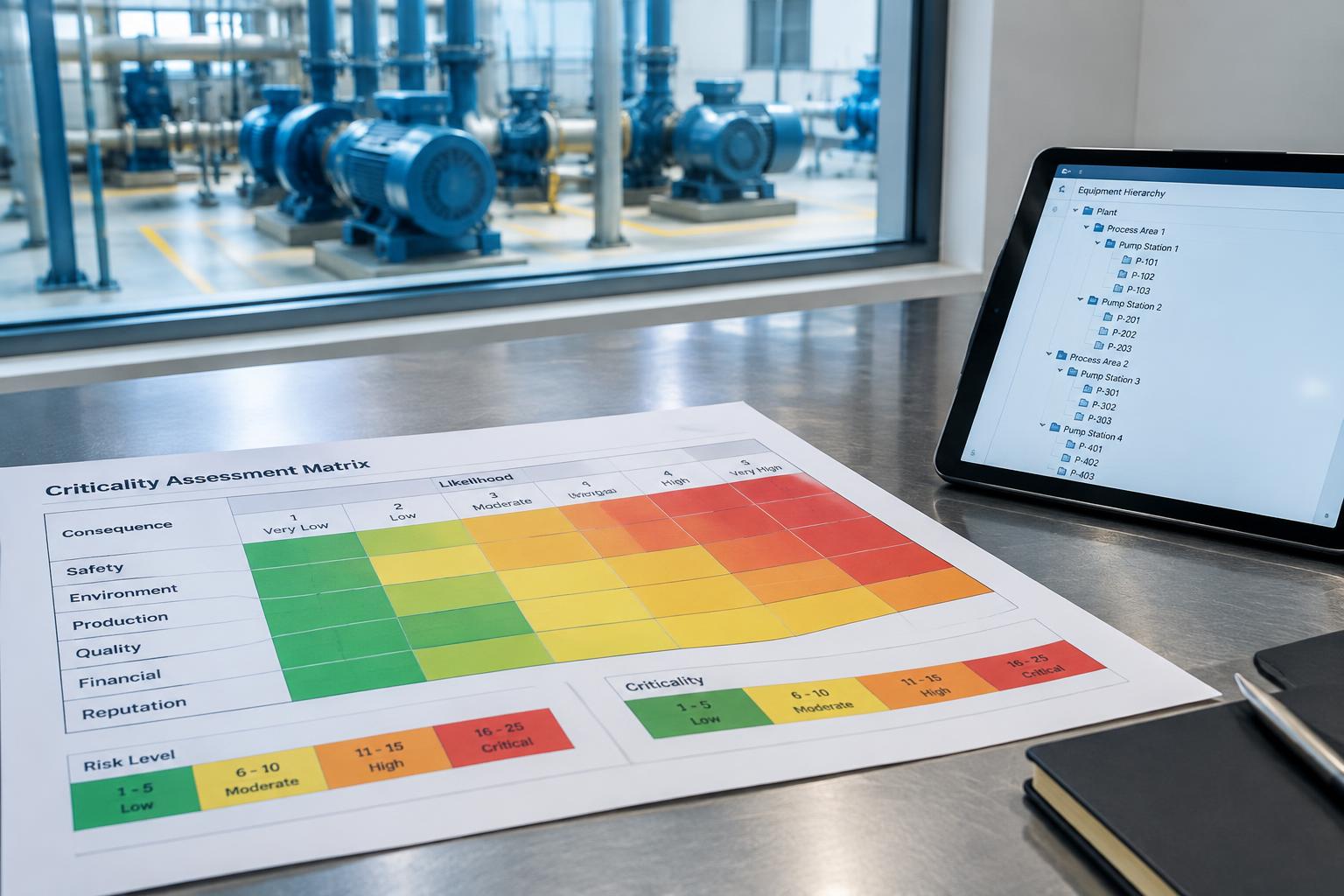
Why rank equipment by criticality?
Not all failures are equal. A redundant sump pump stopping threatens no one; a single process fan failing can halt an entire line or create a safety risk. Equipment criticality analysis gives maintenance, operations and management a common language for deciding where to invest labour hours, spare parts and improvement effort.
The method: four dimensions, one common scale
For each asset, the consequence of a failure is assessed on four dimensions: personnel safety, production, product quality and the environment. Each dimension is scored on a simple scale (for example 1 to 5), then the scores are combined — often by taking the highest score rather than an average, so that a high safety risk is not diluted by low production impact.
| Equipment | Safety | Production | Quality | Environment | Criticality |
|---|---|---|---|---|---|
| Main grinder (single) | 3 | 5 | 4 | 2 | A — critical |
| Transfer pump (redundant) | 1 | 2 | 1 | 3 | C — low |
| Dust collection system | 5 | 2 | 1 | 4 | A — critical |
The example above illustrates an essential point: the dust collector does not stop production when it fails, yet it remains criticality A because of its safety and environmental impact. Without a structured analysis, this type of equipment is often underestimated.
Asset criticality ≠ work order urgency
Criticality is a stable property of the asset; urgency is a property of the current situation. A minor leak on a class A asset can wait for the next planned window, while a complete breakdown on a class C asset may require immediate action if redundancy is already lost. The two dimensions combine in a prioritization matrix: asset criticality on one axis, task urgency on the other.
Putting the analysis into practice
- Build a mixed team (maintenance, operations, safety) to score equipment — never a single person.
- Define written scoring criteria with concrete examples for each level, so two teams score the same way.
- Start with the most important systems rather than covering everything at once.
- Use the result to adjust maintenance plans, spare parts stock and inspections — otherwise the exercise is pointless.
- Review the classification after any process, capacity or regulatory change.
A well-done criticality analysis does not just say what to fix first — it says where every maintenance hour pays back the most.