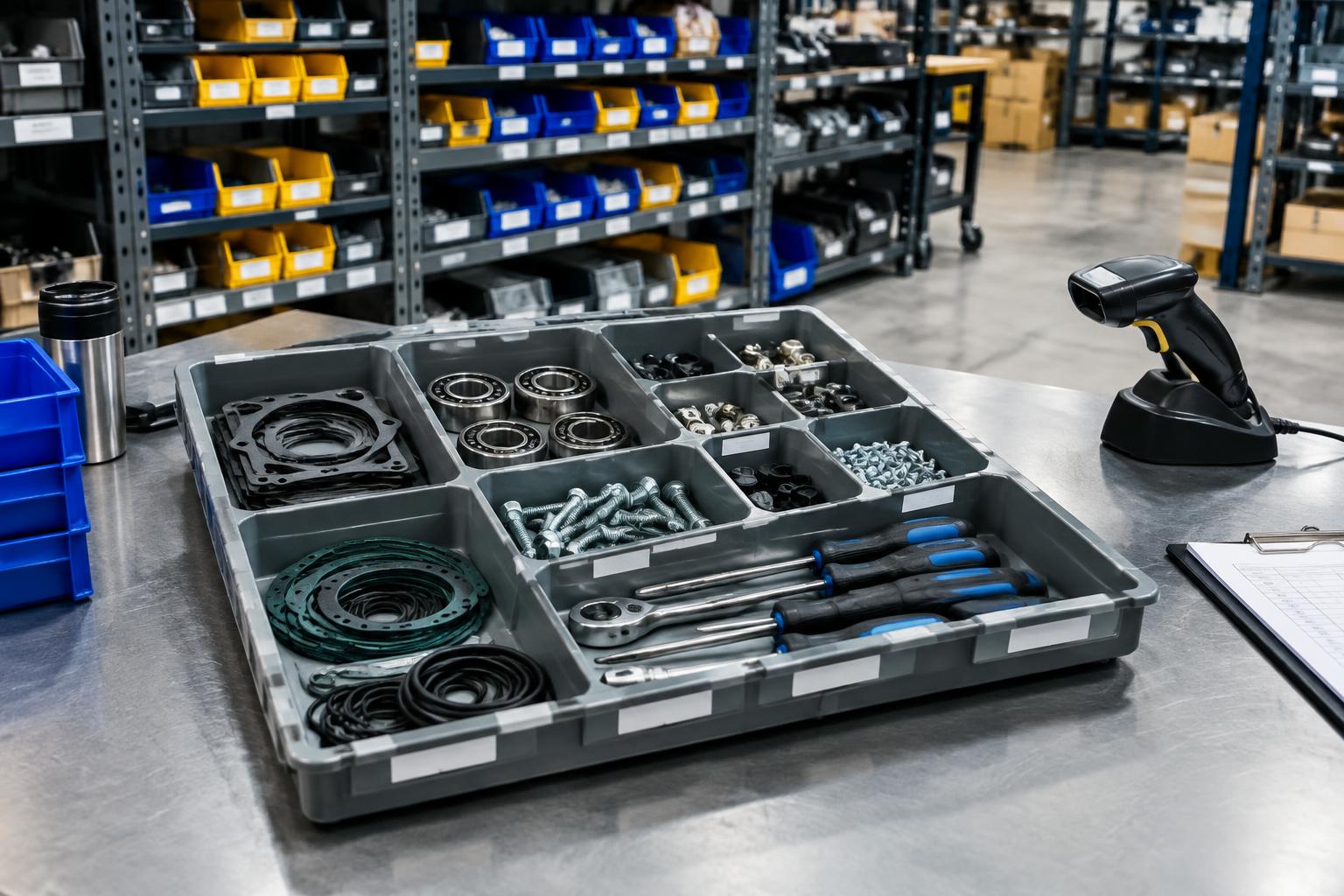
Kitting: logistics serving execution
Kitting means gathering in an identified container all the parts, consumables and special tools needed for a planned job, before the technician shows up. The goal is simple: technician time should be repair time, not search time. In organizations without kitting, a large share of work time is lost travelling to the storeroom — often 20 to 30% by field observation.
The four-step process
- Assemble: pick every item on the work order's parts list, verifying quantities and part numbers.
- Identify: label the kit with the work order number, equipment and planned date.
- Verify: a second person confirms nothing is missing — this is the moment to discover a stock-out, not the morning of the job.
- Store: place the kit in a dedicated, protected area where it waits for its execution date.
Situations that complicate everything
- Missing part: the kit is marked "incomplete" and the work is not released to the schedule — never "start anyway".
- Substitution: any equivalent part must be approved (engineering or planner) and documented on the kit.
- Return of unused parts: every return is counted and put back into stock, otherwise inventories become fiction.
- Postponed work: the kit returns to the waiting area with its revised date — it is never dismantled "to help out".
Is a kit ready? The checklist
- All parts on the list are present, in the right quantity, undamaged.
- Special tools and lifting equipment are reserved.
- Consumables (greases, seals, solvents) are included — they are the ones people forget.
- The kit label allows it to be found in 30 seconds.
Kitting turns the question "do we have everything?" from a morning surprise into a check the day before.